As the Democratic Republic of Congo grapples with the devastating realities of disease and conflict, football has become a rare source of hope, unity, and national pride.
More than half a century after their last appearance at the FIFA World Cup, the Leopards are preparing to return to the grandest stage in football, carrying with them the hopes of millions yearning for a reason to celebrate.
The country’s qualification comes at a particularly difficult period. Communities in eastern DR Congo continue to face the effects of prolonged insecurity, while an escalating Ebola outbreak has deepened national concerns.
According to official government figures released on Sunday, confirmed Ebola infections have risen to 515 after 27 additional positive cases were recorded within 24 hours. Authorities have also reported 91 deaths linked to the outbreak.
Le résultat n’a pas été celui espéré, mais le chemin vers les grandes victoires est souvent pavé d’épreuves, d’ajustements et d’enseignements. #RDC #RDCongo
🐆🇨🇩 pic.twitter.com/w6CkV59HDo— Compte Officiel de Léopards (@fecofa_kinshasa) June 10, 2026
Despite the challenges facing the nation, head coach Sébastien Desabre says his players remain motivated by the desire to represent their country positively during a difficult time.
“The players have all been touched by what has happened in the east of the country,” said Desabre about the Ebola virus outbreak.
“We want to keep up our work and we are looking forward to the chance to keep high the image that the Democratic Republic of Congo deserves.”
International concern over the outbreak continues to grow. The United States Centre for Disease Control (CDC) has warned that the current epidemic could potentially surpass the devastating 2013–2016 West African Ebola outbreak, which claimed more than 11,000 lives.
Against this backdrop, the World Cup offers Congolese citizens a brief opportunity to focus on something beyond the daily headlines.
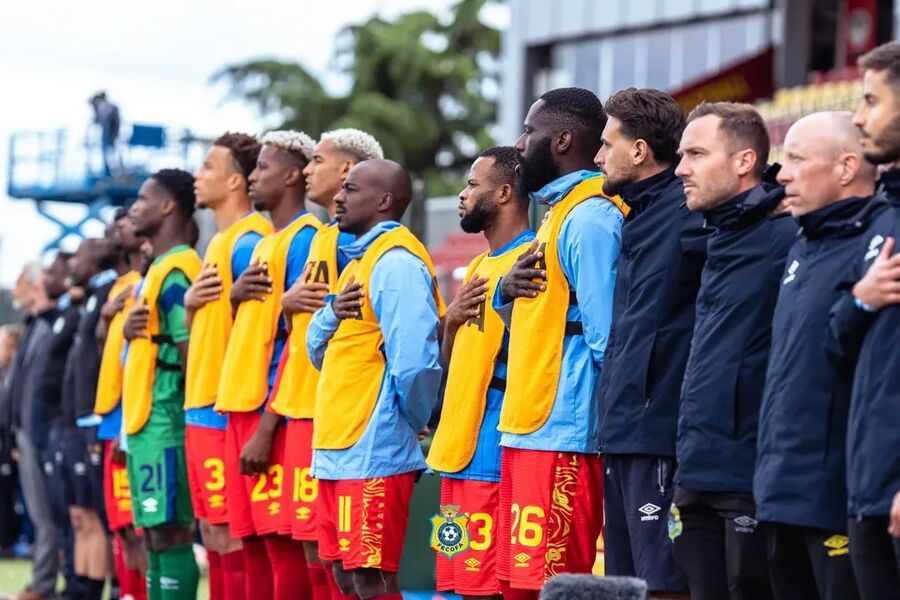
Drawn in Group K alongside Portugal, Colombia and Uzbekistan, the Leopards will make only their second appearance at the tournament and will be eager to prove they belong among football’s elite.
Preparations, however, have not been straightforward.
📸 𝐑𝐄𝐓𝐎𝐔𝐑 𝐄𝐍 𝐈𝐌𝐀𝐆𝐄𝐒
Quelques images de la seconde période de nos Léopards 🇨🇩 face au Danemark 🇩🇰. #RDC #RDCongo #FecofaRdc #FIFA #Congo pic.twitter.com/Eo7mTB9RkM
— Compte Officiel de Léopards (@fecofa_kinshasa) June 4, 2026
The team abandoned plans to hold a pre-World Cup training camp on home soil because of the outbreak and instead established its base in Belgium, with the squad consisting entirely of players based abroad.
Their build-up suffered another disruption when a scheduled warm-up match against Chile in Spain on June 9 was called off amid concerns surrounding the virus.
Under the guidance of Desabre, the former Uganda Cranes coach, DR Congo finally ended its long absence from the World Cup. Their journey to qualification was anything but comfortable. After finishing runners-up behind Senegal in their qualifying group, the Leopards battled past continental heavyweights Cameroon and Nigeria before securing their place with a dramatic 1-0 victory over Jamaica in the intercontinental playoffs.
Now, belief is growing around a squad blessed with talent and experience from across Europe’s top leagues.
Former England international Aaron Wan-Bissaka, who switched allegiance to DR Congo last year, headlines the roster. He is joined by prolific forward Yoane Wissa, dependable defender Axel Tuanzebe, midfielders Edo Kayembe and Noah Sadiki, as well as veteran playmaker Gaël Kakuta.
Together, they form a team determined to achieve what no Congolese side has managed before on the world stage.
📸 𝐑𝐄𝐓𝐎𝐔𝐑 𝐄𝐍 𝐈𝐌𝐀𝐆𝐄𝐒
Quelques images de la seconde période de nos Léopards 🇨🇩 face au Danemark 🇩🇰. #RDC #RDCongo #FecofaRdc #FIFA #Congo pic.twitter.com/n4bq4bcbt3
— Compte Officiel de Léopards (@fecofa_kinshasa) June 4, 2026
When the Leopards step onto the pitch in North America, they will be representing far more than football. They will carry the aspirations of people in Kinshasa, Goma, Bukavu and countless Congolese communities around the globe.
For a nation facing immense challenges, the dream is not necessarily about lifting the trophy. It is about seeing the DR Congo celebrated for resilience, talent and unity, and, for a few unforgettable weeks, being known for football rather than hardship.