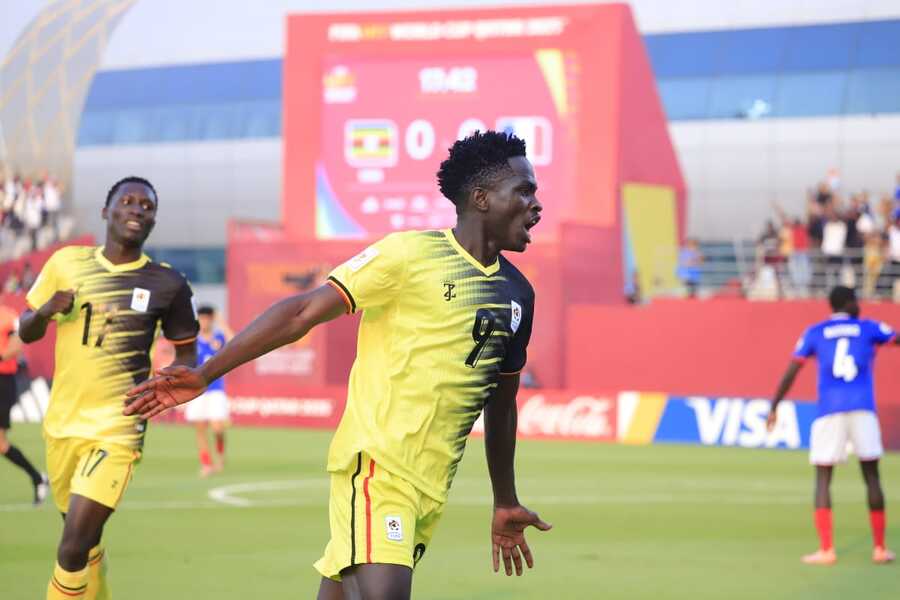
James Bogere did not tiptoe into the Uganda Cranes setup. He arrived like someone who already knew the door was his to open.
When head coach Paul Joseph Put unveiled his final 28-man squad for AFCON 2025, one detail immediately reframed the entire list: a 17-year-old forward was not included as sentiment, symbolism, or succession planning. He was included because he belongs.
At an age when most players are still being introduced to tactical diagrams and physical conditioning plans, Bogere is being trusted with Africa’s biggest football stage. Not later. Not someday. Now.
Progress without Drama
Bogere’s ascent has been striking precisely because it lacked chaos.
There was no viral moment that forced attention, no overnight explosion that distorted expectations. Instead, there was momentum, steady, compounding, undeniable.
At El Cambio Academy, coaches watched a forward sharpen layer by layer. His pace was the foundation. His self-belief followed. Decision-making and finishing arrived last, completing the profile. Each step fed the next.
By 2024, the question was no longer if he would be noticed, but how long Uganda could pretend not to see him. That pretense ended in Kampala.
CECAFA: where he took control
At the U-17 CECAFA Championship, Bogere didn’t wait for permission to lead the line. He dictated it.
Seven goals came in different forms and at different times, but they all carried the same message: this team would not move without him. Uganda’s qualification for the U-17 AFCON was not a collective accident—it was driven.
At the continental tournament, the pattern held. Three goals and two assists in four matches barely scratch the surface of his influence. Bogere played forward-facing football, asking for the ball under pressure, forcing defenders into uncomfortable decisions.
He wasn’t surviving matches. He was shaping them.
When the world was watching
The U-17 World Cup has a habit of swallowing young talent whole. Bogere resisted the tide.
Against Canada, he scored Uganda’s first-ever goal at a FIFA World Cup—an act that instantly redefined the nation’s presence on that stage. Against France, he delivered something even heavier: belief. One finish, one upset victory, one moment that said Uganda was not there to observe.
Round of 16 finish on debut followed. The youngest squad at the tournament played with none of the fear usually assigned to newcomers.
When Uganda were eliminated by Burkina Faso on penalties, Bogere was not on the pitch. Suspension kept him in the stands. The silence his absence created spoke loudly.
Leap that came early
Europe’s interest was inevitable. Aarhus moved first, securing his signature and validating what performances and metrics had already aligned on.
Initially, his call-up to the Cranes looked like a lesson, an education in tempo, intensity, and senior-level expectations.
Then came training.
Then came the AS FAR Rabat friendly.
Bogere did not play like a student. He pressed defenders, attacked space, and unsettled seasoned internationals. The difference between exposure and contribution disappeared.
This was not a rushed gamble either. Bogere had already been integrated into CHAN preparations earlier in the year. The coaching staff knew the player. Familiarity softened the risk. Performance erased it.
Why Morocco needs him
No one is asking Bogere to shoulder Uganda’s attacking burden. That weight rests elsewhere.
But tournaments are not decided solely by first elevens. They hinge on broken patterns, late runs, tired defenders, and moments when structure collapses.
Bogere offers disruption. He stretches backlines. He runs early. He plays with immediacy.
Against opponents like Tunisia, Nigeria, and Tanzania, those traits are not luxuries—they are weapons.
Brain Jjara the Pulse: Uganda’s maestro powered historic U-17 World Cup run
More than a name on the list
Two players, Charles Lukwago and David Owori, do not make the final cut. Bogere does.
It is a subtle decision with loud implications. This is a squad selected on output, not seniority. On readiness, not patience.
Uganda begin their AFCON campaign against Tunisia on Tuesday. Whether Bogere features from the start or arrives later is almost irrelevant.
What matters is this: at 17, James Bogere is no longer football’s future tense.
He is present, and Uganda is prepared to let him prove it.