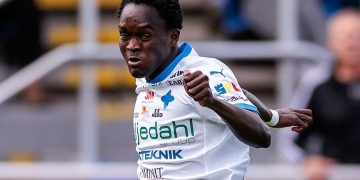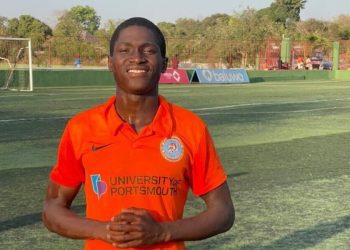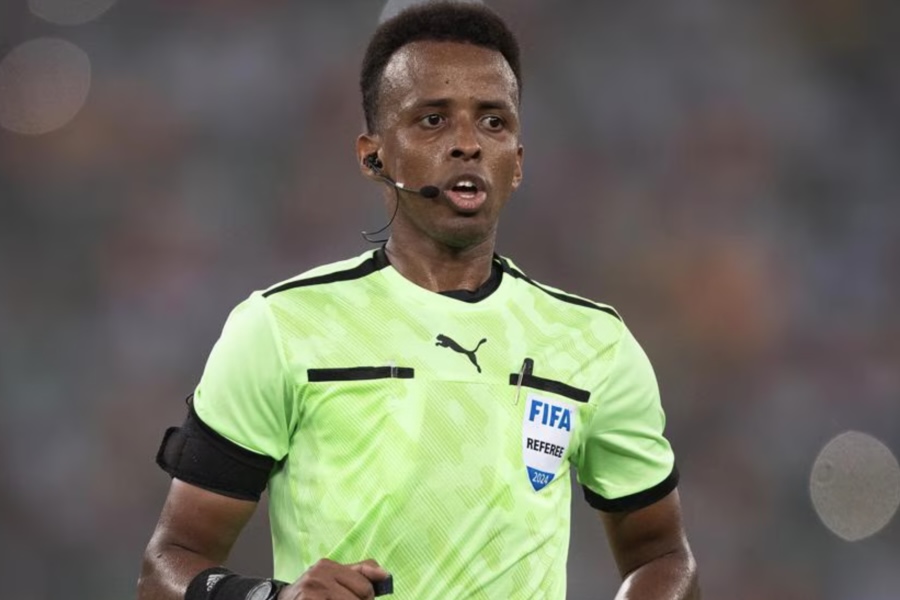
Former FIFA referee Jelil Adeniran Ogunmuyiwa during an exclusive interview with Footy-Africa believes UEFA’s decision to appoint Somali official Omar Artan to the UEFA Super Cup is a significant gesture of recognition, although it may not fully compensate for the disappointment of missing out on the 2026 FIFA World Cup.
Omar, who was named among the referees selected for the expanded 2026 World Cup, saw his hopes of making history as the first Somali to officiate at a senior FIFA World Cup dashed after he was reportedly denied entry into the United States and forced to return home.
In a move widely interpreted as a show of support, UEFA has now appointed Omar as part of the officiating team for the UEFA Super Cup between UEFA Champions League winners Aston Villa and the Europa League champions.
Speaking on the development with Footy-Africa, Ogunmuyiwa described the appointment as both a personal achievement for Omar and a positive moment for African football.
“This is just a way of appreciating the referees because, as I said last time, psychologically, the person will be affected,” Ogunmuyiwa said. “All those smiles on his face may not reflect what is really going on in his mind. But with this opportunity now coming up, he will be the first African to have such an opportunity. So, it is a great privilege for him. It is a great achievement and an additional milestone in his profile, as well as a positive development for Africa as a whole.”
‘It may not erase the pain’
Asked whether the UEFA appointment was enough to erase the pain of missing the World Cup, Ogunmuyiwa acknowledged that the recognition could not completely replace the opportunity Omar lost.
“No, it might not be enough,” he said.
“It might not be enough, but at least it shows that people are concerned. It also shows that UEFA is trying to use football to unite the world.”
The former referee warned that failing to respond to the controversy surrounding Omar’s exclusion could have sent the wrong message ahead of the 2026 World Cup, which will be jointly hosted by the United States, Canada and Mexico.
African refereeing community criticizes FIFA after Somali official incident at World Cup
“If what happened in the United States were allowed to pass without any response, we might face further issues,” he added.
“People are now comparing Qatar 2022 with the USA, Canada and Mexico 2026 tournament. They are comparing what many expected would happen in Qatar with what is happening now. For me, what UEFA did was the right thing, and that is commendable.”
‘Not an embarrassment for FIFA’
Ogunmuyiwa also dismissed suggestions that UEFA’s intervention could place FIFA under pressure or embarrass world football’s governing body.
Instead, he described the appointment as an example of cooperation between football confederations.
“I don’t think so. I don’t think so at all,” he said when asked whether FIFA would be embarrassed by UEFA’s decision. “If you look carefully at what Canada has been suggesting over the last two days, Canada was of the view that they could bring him in to officiate matches there. However, Canada may not realize that this cannot happen without FIFA’s approval.”
“What UEFA has done is more like fostering a relationship between UEFA and CAF. We see similar arrangements in Asia. Even in the UAE, league matches are often officiated by referees from France. It is simply a matter of cooperation between federations and confederations.”
Somali referee Omar Artan speaks out after denied entry to the US for World Cup
Ogunmuyiwa avoids political debate
The former FIFA official was, however, reluctant to be drawn into the political controversy surrounding reports that US authorities alleged Omar had been involved in meetings with suspected Al-Shabaab members.
Ogunmuyiwa said the matter was beyond the remit of football and should be left to the relevant authorities.
“Well, I do not want to comment on that because, to me, it is a political issue, and I would rather not get involved,” he said.
“It is a diplomatic matter, and I believe the appropriate authorities will handle it. That is my view.”
While questions continue to surround the circumstances that prevented Omar from participating at the World Cup, UEFA’s decision ensures the Somali official remains on a major international stage.
For many within African football, the appointment represents both recognition of his abilities and a statement of solidarity following one of the most disappointing moments of his refereeing career.