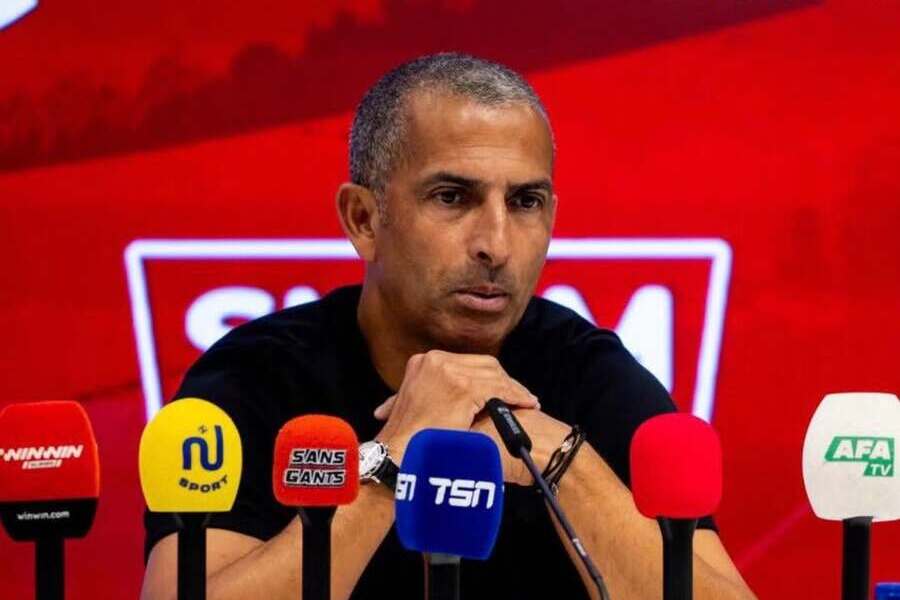
Former Nigerian national team coach John Obuh in an exclusive interview with Footy-Africa shared his technical assessment of the Tunisia federation’s decision to fire Sabri Lamouchi, team’s tactical shortcomings, and their chances of survival in Group F against Japan and the Netherlands.
Tunisia’s 2026 FIFA World Cup World Cup campaign has been thrown into complete disarray following a devastating 5-1 opening-match defeat to Sweden, which led to the immediate sacking of their manager Sabri Lamouchi.
The North African side was set to employ former international midfielder Wabhi Kazhri as the interim gaffer for the rest of the tournament, but the Federation have now decided to appoint former Ivory Coast and Morocco head coach Herve Renard as Lamouchi’s replacement.
”The World Cup is no place for experiments”
Reflecting on Tunisia’s collapse, Obuh emphasized that the elite level of international football leaves absolutely zero margin for administrative or tactical errors.
”The World Cup is a stage where you must be fully prepared before you attend to it,” Obuh exclusively told Footy-Africa.
“It’s not a place where you just go and try anything, or where you have to go and make adjustments that are supposed to be made earlier on before the competition. It’s a tournament that brings out the best. Whoever attends the World Cup should be able to get prepared.”
While panicking after a single matchday is highly unusual, Obuh hinted that the rapid dismissal suggests deeper issues were brewing behind the scenes long before kickoff.
”I’m not an advocate of making changes in the middle of a tournament, it does not make any sense,” Obuh admitted.
“But such a thing is already pre-planned. If you see any country behave like their federation did, they had a doubt earlier on before they gave him the mantle to lead the team. Their doubt happened to establish itself, and that is why they had to do it.”
Obuh also noted that the burden of such a humiliating defeat must be shared collectively between the staff and the squad.
”Tunisia is a country we have always believed can present a good performance at the World Cup,” Obuh said. “But if you are not fully prepared psychologically, and by your selection of the players you brought into the competition, you are bound to have issues. Not every blame goes to the coaches; at times, some of these blames go to the players.”
Посмотреть эту публикацию в Instagram
Tactical illusion: possession without penetration
During the game,Tunisia dominated ball possession, yet they were brutally torn apart by Sweden who had Liverpool’s Alexander Isak and Arsenal’s Viktor Gykores in the attack.
Obuh however dismissed the idea that dominating the ball inherently means a team played well, warning that modern football rewards clinical execution over empty passing metrics.
”Statistics don’t win football,” Obuh explained. “It gives you the opportunity to have an idea of how the football is going, but it does not give you a breakthrough. Most times, you might be in possession of the ball for almost 80% of the game, and the team with 20% will win. It doesn’t give you the actual end result.”
”They did not take their chances, and they were not nearby scoring,” Obuh analyzed. “You kept possession, but at the final third, it does not give you the opportunity to score. So, what is the possession for? If you can play a ball from your goal post into the 18-yard box of the opponent and score without five or ten people touching it, you have won the game.”
”But if ten people touch the ball, you get into the box, they defend it, and you don’t score, what is possession meant for? Everybody is looking at that entrance that the net protects. In any way you can get it in there, that’s what people want at a World Cup. Style is nice, but it’s who scores the highest goals that wins.”
10 coaches tasked with carrying Africa’s dreams at the 2026 FIFA World Cup
Can Tunisia survive Japan and the Netherlands?
With a technical shake-up now underway, Tunisia faces a mountain to climb in their upcoming group fixtures against Japan and the Netherlands.
Despite the catastrophic start, Obuh refuses to completely write off the North Africans, noting that a managerial switch can occasionally spark an unpredictable resurgence.
”Football being what it is, the first game is always an important game, but it is a trial to so many coaches,” Obuh concluded. “I don’t think they will approach the second game the way they approached the first. Unfortunately, they have made changes to their technical crew. I wouldn’t want to say whether that will help or not help, but football being what it is, they might come out stronger than they did and present a better squad.”